

Africa Faces Urgent Counter-UAS Imperative Amid Surge in Militant Drone Warfare
Non-state armed groups across Africa have dramatically escalated their operational capabilities by deploying weaponized unmanned aerial systems (UAS) against military installations, forcing continental defense sectors to rapidly prioritize counter-drone architectures. This technological pivot transitioned from tactical surveillance into active kinetic warfare following a series of coordinated strikes in the Lake Chad Basin and Sahel regions. With insurgent drone operations tripling annually, African militaries are facing an immediate logistical mandate to procure, develop, and integrate comprehensive counter-UAS (C-UAS) frameworks to safeguard sovereign territory and defense personnel.
The Rapid Escalation of Asymmetric Aerial Attacks
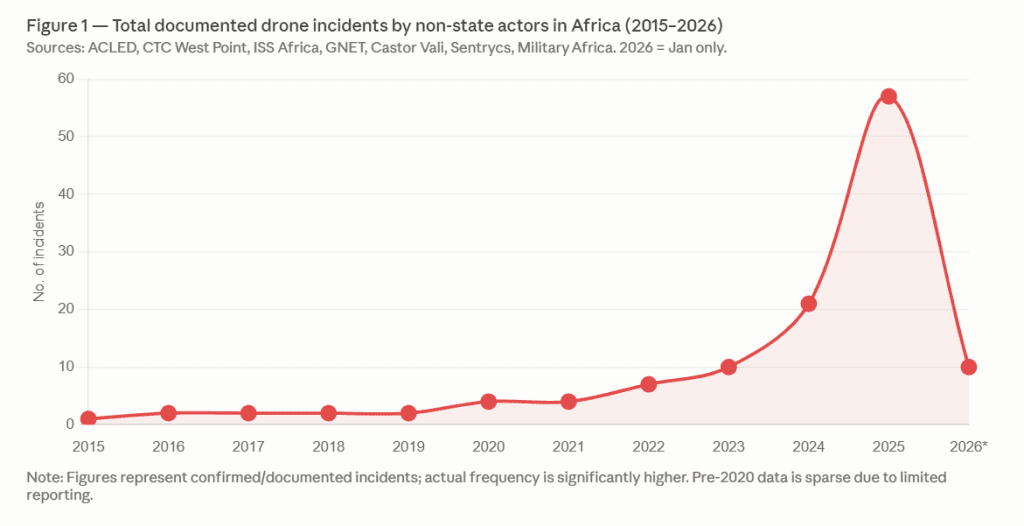
The statistical trajectory of drone deployments by militant factions across the continent reflects a major transformation in regional conflict dynamics. Documented aerial incidents involving non-state actors rose from sporadic occurrences over the last decade to dozens of confirmed kinetic strikes annually. This sudden surge is primarily driven by coordinated campaigns from groups such as Jama’at Nusrat al-Islam wal-Muslimin (JNIM), the Azawad Liberation Front (FLA) in northern Mali, and the Islamic State West Africa Province (ISWAP) in the Lake Chad Basin.
A prominent example of this shifting threat materialized when the Islamic State Sahel Province (ISSP) executed a massive coordinated assault utilizing approximately ten kamikaze drones simultaneously against an international airport facility in Niamey, Niger. These operations demonstrate that insurgent factions have moved far beyond basic reconnaissance into complex, multi-wave kamikaze and first-person view (FPV) drone maneuvers. These advanced techniques are frequently adapted from foreign conflict theaters and specialized knowledge transfers.
                  AFRICAN INSURGENT DRONE EVOLUTION

      [ 2018 - 2020 ] ---> Intelligence, Surveillance, & Reconnaissance (ISR)
                           * Used to map outposts and guide ground troops.
        |
      [ 2023 - 2024 ] ---> First-Person View (FPV) & IED Drops
                           * Improvised explosives dropped onto defensive grids.
        |
      [ 2025 - 2026 ] ---> Coordinated Kamikaze Swarm Operations
                           * Multi-drone synchronized attacks on strategic infrastructure.
Defensive Architecture Gaps and Material Casualties
The lack of systematic, layered counter-UAS protection across many African military formations has resulted in severe operational vulnerabilities and mounting casualties. Armed groups routinely utilize remote aerial reconnaissance to map out remote forward operating bases before launching multi-wave ground assaults or dropping locally modified explosives directly into defensive trenches. Incidents cutting across northeastern Nigeria, northern Mali, Burkina Faso, and Cameroon have repeatedly highlighted the destructive precision of these low-cost aerial assets when deployed against unprotected targets.
Standard counter-drone doctrine requires an integrated architecture combining radio-frequency jamming, electronic warfare GPS spoofing, kinetic interceptors, and advanced acoustic or radar detection networks. While defense leadership in nations like Nigeria have publicly acknowledged the threat and begun deploying specialized jamming equipment, systematic counter-drone programs remain severely limited across the broader Sahelian and West African sub-regions. This technological gap leaves frontline forces exposed to highly adaptable aerial strategies that evolve faster than traditional defensive protocols.
Domestic Production and Regional Integration Strategies
To successfully neutralize the expanding aerial threat, regional defense analysts emphasize a three-track operational strategy centered on immediate procurement, domestic industrial development, and cross-border intelligence integration. In the short term, heavily exposed nations are looking to secure combat-verified C-UAS systems from established international defense contractors. The upcoming Africa International Defence Exhibition (AFRIDEX) in Lagos is expected to serve as a primary procurement node connecting African defense officials with global electronic warfare and counter-drone manufacturers.
  +-----------------------------------------------------------------------+
  |              THREE-TRACK CONTINENTAL C-UAS FRAMEWORK                  |
  +-----------------------------------------------------------------------+
  |  1. IMMEDIATE PROCUREMENT   | Acquire combat-proven electronic warfare |
  |                             | and jamming suites from global markets. |
  +-----------------------------------------------------------------------+
  |  2. INDIGENOUS PRODUCTION   | Leverage domestic industrial plants to  |
  |                             | engineer localized counter-drone tech.  |
  +-----------------------------------------------------------------------+
  |  3. REGIONAL INTEGRATION    | Establish shared early-warning networks  |
  |                             | across ECOWAS and the African Union.    |
  +-----------------------------------------------------------------------+
To avoid long-term foreign dependency traps, the continent is also pivoting toward domestic manufacturing capabilities. Facilities like Africa’s largest drone production plant in Abuja, alongside institutional collaborations between defense corporations and local tech firms, represent the foundational industrial base needed to design and construct indigenous counter-drone solutions. Finally, because these insurgent groups operate across highly fluid borders, organizations like the Economic Community of West African States (ECOWAS) and the African Union (AU) must institutionalize shared early-warning detection networks, ensuring that collective security frameworks match the transnational reach of modern drone warfare.