




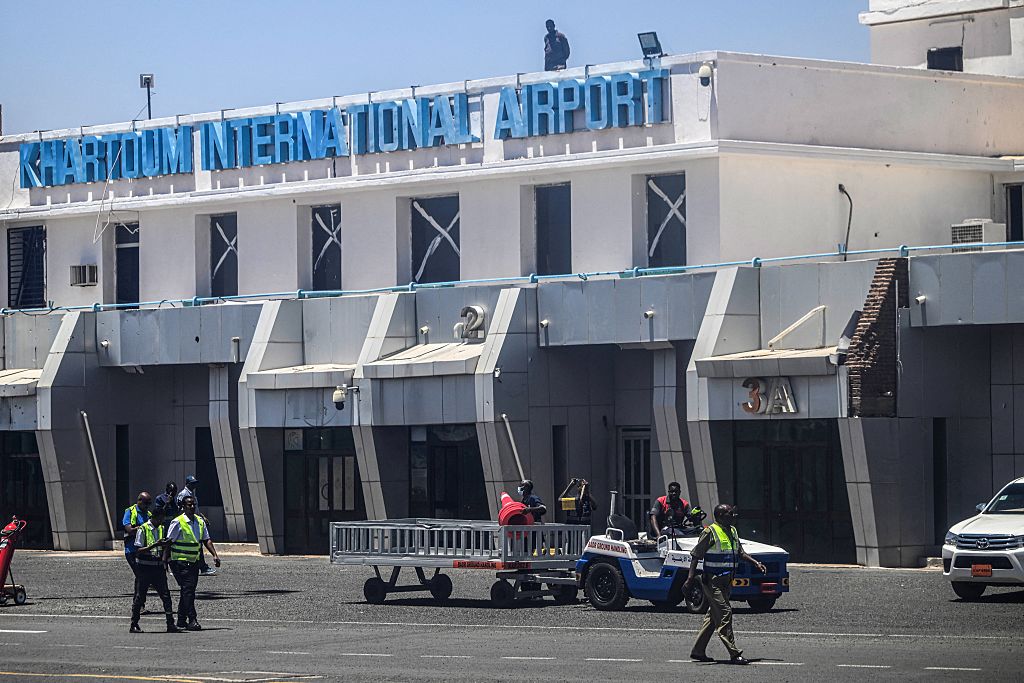
A series of targeted drone strikes on Khartoum International Airport has pushed the long-simmering rivalry between Sudan and Ethiopia toward a direct state-on-state confrontation. The aerial assault, which paralyzed key civil aviation structures and air defense networks in the Sudanese capital, has dramatically accelerated the regionalization of Sudan’s internal conflict, pulling neighboring Horn of Africa powers into a highly volatile proxy crisis.
Strategic Aviation Node Targeted in Khartoum
The drone offensive breached the airspace of the capital to execute precision strikes on critical infrastructure, including civil passenger terminals, a primary radar system, and an active air defense grid. The operation materialized just one week after the airport had celebrated a cautious milestone: welcoming 300 returning citizens on the first international commercial flight to land in the capital since the civil war erupted.
Security analysts emphasize that the strike was meticulously timed to disrupt emerging stabilization efforts by the Sudanese Armed Forces (SAF). By intentionally targeting air monitoring assets and civilian transit spaces, the assault successfully re-established Khartoum’s skies as an active combat envelope and effectively severed the capital’s newly restored lifeline to the international community.
Intelligence Data Traces Launch Points to Ethiopia
The underlying mechanics of the assault ignited an immediate diplomatic firestorm when the SAF explicitly blamed the Ethiopian government for orchestrating a direct act of cross-border aggression. According to technical documentation processed by Sudan’s Ministry of Foreign Affairs, forensic engineering teams successfully recovered flight logs and serial identifiers from the downed aircraft:
-
Manufacturing Records: Data traced via the drone’s serial footprint (S88) confirmed the airframe was procured from the United Arab Emirates (UAE).
-
Operational Origin: Telemetry analysis indicated the drone was piloted and launched directly from within Ethiopian territory, specifically operating out of Bahir Dar Airport.
Addis Ababa issued an immediate and total denial, shifting the narrative by accusing the SAF of weaponizing and financing Tigrayan mercenaries along its western frontier. The Ethiopian ministry claimed that Khartoum has increasingly transformed into a strategic rear-base for anti-Ethiopian elements, alleging that Sudan’s accusations are being manufactured at the behest of “external patrons”—a thinly veiled reference to Egypt, the SAF’s principal regional ally.
Overlapping Fault Lines and Border Mobilization
The sudden spike in hostilities marks a dangerous convergence of Sudan’s civil war with Ethiopia’s domestic structural crises. Ethiopian Prime Minister Abiy Ahmed is currently balancing multiple geopolitical flashpoints, including internal military campaigns in the Amhara and Oromia regions, unresolved tensions with Eritrea, and a major maritime dispute over Red Sea access.
Furthermore, the persistent regional fallout over the Grand Ethiopian Renaissance Dam (GERD) on the Nile River has long pitted Ethiopia against downstream Egypt and Sudan. While regional experts note that Egypt, Eritrea, and Sudan do not form a rigid “anti-Ethiopia alliance,” their strategic interests are steadily aligning around containing Addis Ababa’s expanding footprint.
In direct response to the airfield bombardment, the SAF has moved swiftly to militarize its frontier. The high command announced extensive troop deployments and defensive fortifications across critical boundary corridors, heavily reinforcing its positions in:
-
East Gallabat
-
Basunda
-
Al-Fashaga (Gedaref State)
This aggressive border buildup risks morphing local, localized skirmishes into an institutionalized regional war, as both nations now view each other’s domestic survival as a direct threat to their own sovereign stability.