
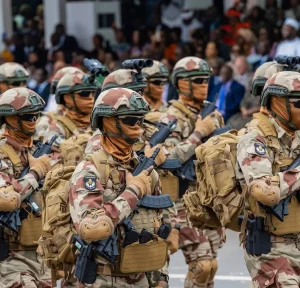



President Bola Ahmed Tinubu officially commissioned three state-of-the-art surface combatants and verified the integration of new tactical aerial and amphibious commands during the Nigerian Navy’s 70th Anniversary International Fleet Review at the Eko Atlantic Waterfront in Lagos on Monday, June 1, 2026. The high-profile deployment of these newly acquired military assets is designed to eliminate transnational maritime piracy, illicit crude oil bunkering, and smuggling networks within the strategic sea lines of communication across West Africa. The international event, attended by multi-national naval delegations and regional heads of state, highlights Nigeria’s commitment to spearheading maritime stability under the wider Economic Community of West African States (ECOWAS) framework.
Fleet Modernization and New High-Speed Surface Combatants
The focal point of the seven-decade milestone was the formal commissioning of three brand-new Fast Patrol Vessels (FPVs): NNS Gurara (P206), NNS Mambila (P207), and NNS Oloibiri (P208). Engineered by China’s Poly Technologies Inc., these 46-meter long-range hulls represent a substantial generation leap over the navy’s older Shanghai III-class legacy platforms. Outfitted with specialized automated weapon tracking systems, remote and manual naval gun stations, and heavy machinery armaments, the hunters are custom-tailored for high-speed interception inside Nigeria’s vast Exclusive Economic Zone (EEZ).
Before entering active frontline status, the trio underwent a grueling three-week integration and stress-testing process overseen by the Naval Doctrine Command (NAVDOC) from late October to mid-November 2025. Crews completed rigorous Basic Operational Sea Training (BOST) and Consolidated Operations Sea Training (COST) phases, culminating in live-fire combat validations. The platforms subsequently achieved immediate operational validation by participating in expansive maritime security maneuvers, including Exercise Omi Ailewu and the Chief of Naval Staff’s Annual Sea Inspection, Exercise Eru Obodo, in late 2025.
Operational Shift Toward Littoral and Amphibious Capabilities
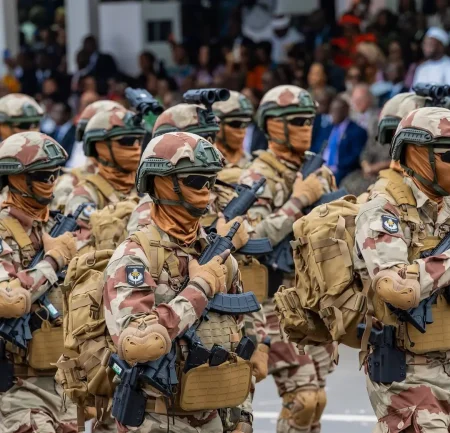
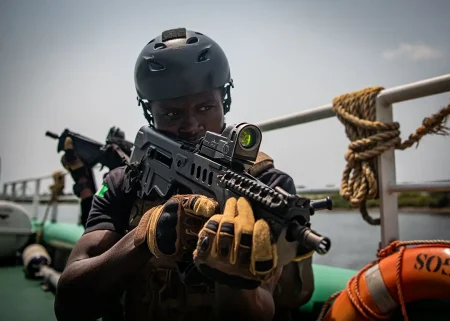
In a significant doctrinal evolution away from traditional blue-water projection, the Nigerian Navy has formally introduced its specialized Nigerian Navy Marines and a high-readiness Special Operations Command. Originally initialized as an operational battalion framework in February 2025, these newly refined amphibious units are trained to deploy alongside the elite Special Boat Service (SBS). This structural transition provides West Africa’s largest economy with the dedicated military architecture needed to execute precision strikes and control fluid security situations across the shallow littoral networks and riverine environments of the Niger Delta.
Complementing this terrestrial force projection is a rapid expansion of naval aviation and surface strength initiated over the past 18 months. Just one year prior, the service integrated three AW109 Trekker multi-role helicopters along with the surface combatants NNS Shere, NNS Faro, and the South Korean-donated Chamsuri-class vessel NNS Ikogosi. The strategic combination of these rotary assets with six fresh surface hulls allows the high command under Chief of Naval Staff Vice Admiral Idi Abbas to sustain multi-layered security corridors across vulnerable maritime trade routes.
Integrating Unmanned Aerial Systems for Persistent Surveillance
The final component of Abuja’s security modernization matrix is the full integration of the advanced AYBARS-2 tactical unmanned aerial vehicle (UAV). Sourced from Turkey’s BMS Defence Technologies Inc. as part of expanding bilateral defense agreements, these tactical drones achieved full operational status in the Gulf of Guinea in January 2026. Operating as persistent aerial eyes in the sky, the unmanned platforms continuously monitor wide maritime zones, providing real-time data feeds to surface interceptors while minimizing direct risk to naval personnel.
President Tinubu emphasized that these systematic technical investments have already generated a measurable impact, effectively suppressing piracy, boosting national oil output, and reinforcing commercial investor confidence across the region. By linking real-time aerial drone intelligence with high-speed surface patrol groups and versatile marine battalions, the Nigerian Navy has effectively repositioned itself as the foundational security anchor for the entire West African subregion.