


The Ministry of Mines, Industry and Technological Development of Cameroon has executed a comprehensive shutdown of all gold-mining activities to reclaim regulatory oversight from unauthorized foreign corporations. Announced officially as a sweeping structural intervention, the government mandate suspends semi-mechanized and artisanal operations primarily managed by Chinese nationals across the country’s resource-rich interior. Under the new guidelines, mining entities will be barred from resuming work until they meet stringent state production targets, implement closed-circuit mineral processing, and post a substantial environmental safety bond.
Combating Systematic Revenue Flight and Trade Discrepancies
Yaoundé’s decisive crackdown addresses severe, multi-billion dollar economic discrepancies within the national gold supply chain. Data published by the Extractive Industries Transparency Initiative (EITI) exposed a massive gulf between Cameroon’s internally documented production metrics and international import statistics. While domestic ministries registered a total output of 953 kilograms of gold, formal customs channels documented a mere 22.3 kilograms in official exports.
Concurrently, international trading partners—most notably the United Arab Emirates (UAE)—reported receiving 15.2 metric tons (15,200 kilograms) of Cameroonian-sourced gold during the exact same period. This statistical divergence reveals that illicit networks successfully diverted nearly 680 times the volume of the country’s officially declared exports into underground circuits. In response, President Paul Biya instituted a specialized investigative panel to trace these transnational smuggling syndicates and enforce criminal liability on both foreign operators and complicit domestic actors.
Enforcement Sweeps and Restructuring Frameworks
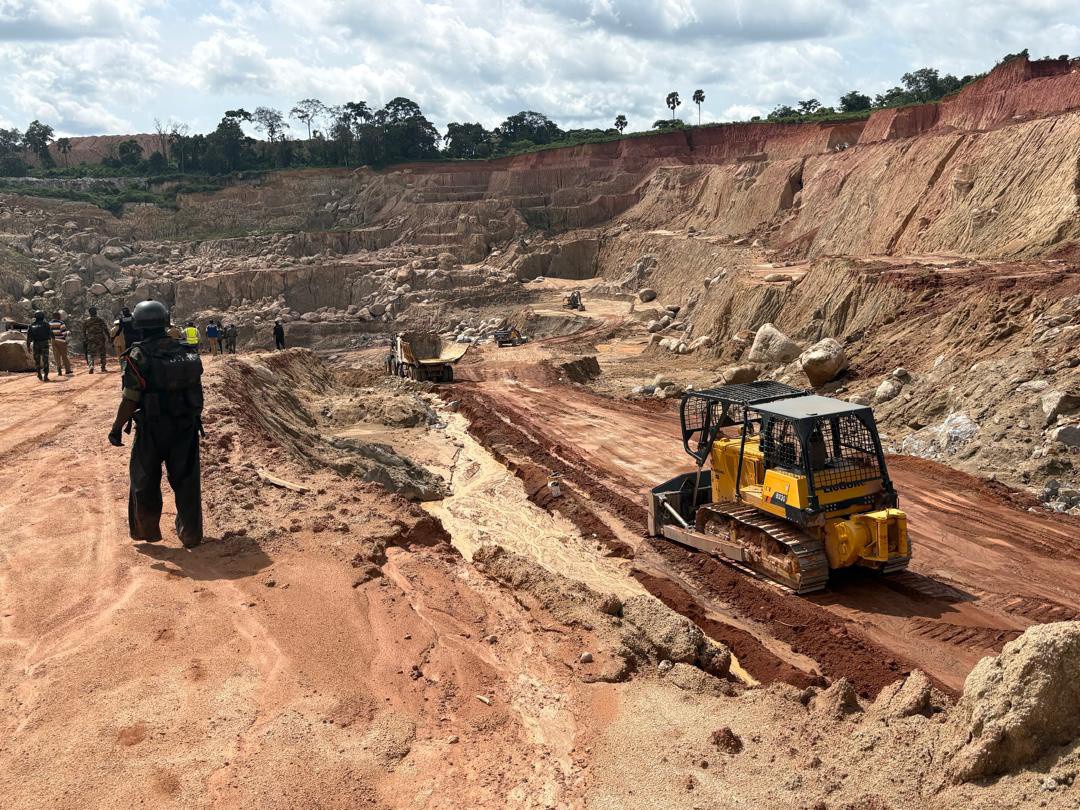
State enforcement operations have intensified rapidly following a census identifying approximately 200 unpermitted mining operations concentrated across the East and Adamawa regions. Acting Minister of Mines Fuh Calistus Gentry, backed by joint detachments of national police and tactical military units, has initiated unannounced inspections to dismantle defiant encampments. These security sweeps have resulted in the immediate seizure of heavy earthmoving machinery, transport fleets, and industrial processing equipment at multiple illicit extraction sites.
To establish structural order, the ministry has introduced non-negotiable regulatory thresholds that foreign operators must satisfy within a six-month window:
-
Up-front Financial Escrow: Companies must deposit an environmental bond exceeding $112,000 before receiving operational clearances.
-
Closed-Loop Processing: Outlaws the traditional open-air chemical washing of ore to secure local water tables.
-
Production Tranches: Mandates fixed, verifiable monthly output targets to halt the flow of unregistered gold into the parallel market.
Mitigating Severe Regional Eco-Toxification
Beyond the profound economic losses, the surge in unregulated mining operations has triggered extensive environmental devastation across Central Africa’s delicate river systems. Independent extractive analysts emphasize that while visible forest clearing represents a severe ecological threat, the invisible chemical contamination of shared waterways poses an immediate danger to local populations.
Unlicensed entities routinely rely on mercury and other hazardous chemical agents to separate gold flakes from raw sediment. Because these processing methods have historically remained entirely uncontained, toxic heavy metals drain directly into local aquatic ecosystems. This uncontrolled run-off causes severe mercury poisoning within the regional food chain, destroys local fisheries, and disrupts essential agricultural lifelines. Yaoundé’s policy shift reflects a wider continental trend as African states increasingly use administrative and military power to eliminate loosely regulated foreign resource exploitation.