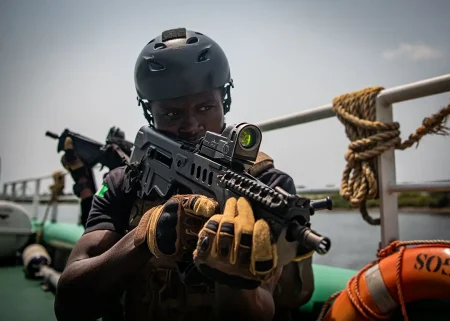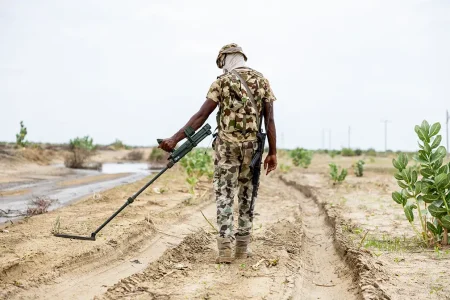



The Defence Industries Corporation of Nigeria (DICON) and its joint venture partner, D7G Nigeria Limited, showcased their locally manufactured military hardware at the SAHA Defence and Aerospace Exhibition 2026 in Istanbul, Turkey. Held from May 5 to May 9, 2026, the international defense forum provided a global stage for Abuja to present its expanding domestic arms manufacturing capability. By displaying advanced infantry weapons and tactical equipment abroad, the state-backed manufacturer aims to signal its growing self-reliance and reduce its historical dependence on foreign military imports.
Strategic Bilateral Cooperation and Technology Transfer
A high-level government delegation led by the Minister of State for Defence, Dr. Bello Mohammed Matawalle, and the Chief of Air Staff, Air Marshal Sunday Kelvin Aneke, managed the diplomatic outreach in Istanbul. Minister Matawalle held extensive bilateral defense talks with the Secretary of Defence Industries of Turkey, Prof. Dr. Haluk Görgün, focusing on accelerated technology transfer, localized capacity building, and joint industrial investments. The Nigerian ministry utilized the exhibition to invite international aerospace and defense firms to establish co-production plants inside Nigeria.
This Turkish appearance follows an earlier international debut at the Doha International Maritime Defence Exhibition and Conference (DIMDEX) in Qatar. Together, these events represent the first coordinated international promotional tour for the state manufacturer since its establishment in 1964. Under the guidance of DICON-D7G executives, including Chief Executive Officer Osman Chennar, the joint venture is positioning itself to evolve from a purely domestic supplier into a competitive regional defense exporter.
Industrial Expansion and Locally Upgraded Infantry Systems
The joint venture framework was originally formalized via a Memorandum of Understanding (MoU) signed in January 2024 to rapidly scale up the domestic production of small arms, ammunition, and armored platforms. The operational cornerstone of this current manufacturing model is the DG-103 assault rifle, a domestically licensed and modified variant of the 7.62x39mm Kalashnikov AK-103. Assembled at the joint venture’s primary industrial facility in Kaduna, the weapon provides frontline infantry units with a reliable, standardized rifle optimized for local counter-insurgency operations.
By late 2025, the Kaduna facility had successfully completed and delivered its initial production batch of nearly 1,000 DG-103 rifles within its first two months of assembly line activation. Beyond baseline kinetic infantry weaponry, DICON-D7G has diversified its research and development matrix to include:
-
Tactical Unmanned Aerial Vehicles (UAVs): Locally assembled drone platforms optimized for tactical intelligence, surveillance, and reconnaissance (ISR) missions.
-
Counter-Drone Architecture: Electronic warfare systems featuring integrated early-warning capabilities designed to detect, track, and neutralize low-altitude aerial threats.
Maritime Logistics Infrastructure and Regional Export Layout
To support this expanding industrial output and manage heavy manufacturing supply chains, DICON-D7G is preparing to launch a dedicated military jetty near the Tin Can Island Port in Lagos in June 2026. This independent maritime gateway will serve as the joint venture’s primary logistics hub, streamlining the bulk import of raw industrial components and raw materials needed for weapons assembly. By bypassing civilian port congestion, the infrastructure project eliminates third-party maritime delays, reduces port demurrage costs, and shortens weapon delivery timelines to active domestic conflict zones.
Following the operational activation of the Lagos maritime jetty, the joint venture plans to maximize the throughput of its Kaduna assembly lines. The expanded production schedule will focus on manufacturing light armored vehicles and small arms destined for regional export markets within allied African nations. This planned export expansion marks a major doctrinal shift for Nigeria, transforming the state from a traditional arms-importing nation into an active provider of regional security hardware across the continent.